Friday, November 29, 2019

Whole circle bearing (WCB) and Quadrantal Bearing System (QBS) in Surveying

The whole bearing system (WBS) and the quadrantal bearing system (QBS) are two bearings systems used in the compass survey. With a simple calculation, the WCB system can be converted to QBS.

The article briefly explains the different bearings used in the survey and classification of bearings (WCB and QB system).

Bearing and Angles:

You may measure a survey line in relation to another survey line or in relation to the meridian. The first method provides the line angle. The second one is giving the bearing The bearing can, therefore, be defined as the line's direction for the given meridian.

There are mainly three types of meridian: 
  1. True meridian 
  2. Magnetic meridian 
  3. Arbitrary meridian

1. True Meridian:

A line passes through a point, with a plane passing through the point and the north-south poles forming the true meridian.
In other words, it forms the line that passes through the true north and the south poles.
The true bearing of a given line is the horizontal angle made with the true meridian through one of the extremities of the line.

2. Magnetic Meridian

The magnetic meridian is the direction shown by a freely suspended and floating balanced magnetic needle. To determine the magnetic meridian, a magnetic compass can be used. For this purpose, the magnetic compass used must be free of other attractive forces. 
The magnetic bearing of a given line is the horizontal angle that it makes with the magnetic meridian that is passing through one of the extremities of the line.

3. Arbitrary Meridian

In some situations during the survey, a convenient direction is set for a permanent or common mark or signal in the area. These are called arbitrary meridians which help determine the survey line's relative positions.
The horizontal angle made by a line with the arbitrary meridian passing through one of its extremities is called as an arbitrary bearing.

Whole Bearing and Quadrantal Bearing Systems:

A WCB bearing system measures an angle in the clockwise direction from the magnetic north or to the south.


hence, the bearing value varies between 0 degrees and 360 degrees. A WCB system graduates from a prismatic compass. 


The Quadrantal Bearing or Reduced Bearing System (QB):

The bearing angle is measured in the QB system either from the north or from the south, whichever is nearer. In either clockwise or anti-clockwise, this can be measured Here it is necessary to mention the quadrant at which the line lies. The Q.B lines vary from 0 to 90 degrees.


Friday, November 22, 2019

What is Leveling and types of Leveling? Surveying & Leveling

What Is Leveling?

Leveling is a civil engineering survey branch of measuring levels at different points with respect to a fixed point such as building elevation one-point height from the surface, etc.


Types of Leveling in Surveying.


  1. Direct leveling
  2. Trigonometric leveling
  3. Barometric leveling
  4. Stadia leveling

Direct Leveling:

It is the most commonly used leveling process. Measurements are directly observed from the leveling instrument in this process.
 Direct leveling is divided into different forms on the basis of observation points and instrument positions as follows:
  •     Simple leveling
  •     Differential leveling
  •     Fly leveling
  •     Profile leveling
  •     Precise leveling
  •     Reciprocal leveling

Simple leveling:

It is a simple and fundamental method of leveling in which the instrument of leveling is positioned between the points to be found in elevation. At that point, leveling rods are placed and viewed by means of a leveling instrument. Only when the points are nearer to each other without any barriers is it done.

Differential leveling:

When the distance between two points is greater, differential leveling is performed. The number of interstations is located in this process and the instrument is shifted to each station and the elevation of interstation points is observed. Finally, the difference is determined between the initial two points.

Fly leveling:

When the benchmark is very far from the workstation, fly leveling is performed. In such a case at the work station, a temporary benchmark is placed based on the original benchmark. It is used to evaluate approximate standard, even if it is not highly accurate.


Profile leveling:

Typically, profile leveling is adopted to identify points along a line such as a road, rail or river, etc. In this case, intermediate station readings are taken and each station's reduced level is found. From this alignment, the cross-section is drawn.

Precise leveling:

Precise leveling is similar to differential leveling, but higher precision is expected in this case. Serious analysis technique is conducted to achieve high precision. The accuracy is achieved by 1 mm per 1 km.

Reciprocal leveling:

If the leveling device can not be found between the inter-visible points, reciprocal leveling is carried out. In the case of lakes or streams, etc., in the case of mutual leveling, the instrument is placed closer to the first station and sighted to the second station.

Trigonometric Leveling:

It is called trigonometric leveling the leveling process in which the point elevation or the difference between points is determined from the observed horizontal distances and vertical angles in the field. Trigonometric relationships are used in this method to calculate a point elevation from an angle and horizontal range, so it is called trigonometric leveling. It is also referred to as indirect leveling.

Barometric Leveling:

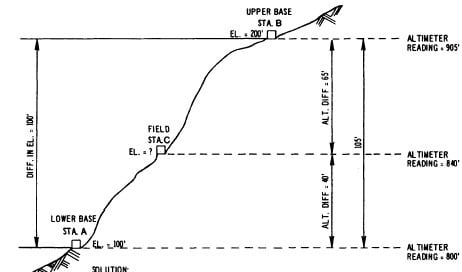
A barometer is an instrument used to calculate at any altitude atmosphere. Thus, in this leveling method, atmospheric pressure is observed at two different points on the basis of which the vertical difference is determined between two points. It is a rough estimate and is rarely used.


Stadia Leveling:


It is a modified form of trigonometric leveling in which the principle of Tacheometer is used to calculate the point elevation. The line of sight is angled from the horizontal in this case. It is more accurate and suitable in hilly terrain for surveying.