Saturday, December 7, 2019

English Bond and Flemish Bond – Features & Difference

English Bond and Flemish Bond – Features & Difference

English Bond and Flemish Bond – Features & Difference


The English bond and the Flemish bond are the two most common types of brick masonry used in wall construction. An English bond is formed by a brick construction pattern with alternate brick courses laid as stretchers and headers. A flemish bond is a design of brick building consisting of alternate stretchers and headers for each course.

English Bond

For almost all wall thicknesses, an English bond can be built Among all other bonds, this bond is the strongest. This bond is made up of alternate header and stretcher courses. The vertical joints overlap one another. This is also followed by the stretcher course's vertical joints. The vertical joints are broken by using a queen closer to prevent the joints from forming inline. The queen closer is placed for each heading course after the quoin header.

Features of English Bond

The basic features of English Bond are:
  1. No continuous vertical joints are formed.
  2. In the elevation, the alternate course either shows headers or stretchers.
  3. Every header in an alternative course comes centrally over the joint formed by two stretchers below it.
  4. The stretchers have a minimum lap of one-fourth their length over the headers. This is the case for the stretcher course.
  5. Those walls with even multiple half bricks show the same appearance on both the faces. Hence a course that shows stretchers on the front face would show stretchers on the back face.
  6. Those walls with odd multiple half bricks show stretchers on one face and the headers on the other dace.
  7. The middle portion of the thicker walls consists of headers.
  8. Queen closer is not required for a stretcher course. It is used for the header course placed just after the quoin header. No header course should start with the queen closer.
  9. The joints formed in the header course are greater (twice) than the stretcher course. Hence the joint in the header course is made thinner compared to the joints in the stretcher course.

Flemish Bond

A Flemish bond pattern consists of each course of alternate headers and stretchers. Every alternate course starts with a quoin header at the corner. To the next of quoin header, quoin closer is placed in alternate courses to develop face lap. The patterns arrange such that every header is centrally supported over the stretcher below it.
Flemish bonds can be either:
  1. Double Flemish Bond
  2. Single Flemish Bond

1. Double Flemish Bond

In each course, a double flemish bond with alternating headers and stretchers. The feature of the double flemish bond is that it has the same color on both the front and back sides. This feature, therefore, gives a better appearance for all wall thickness compared to the English bond.

Features of Double Flemish Bond

The basic features of Double Flemish Bond are:
  1. Each Course has headers and stretchers placed alternately.
  2. The facing and backing of the wall have the same appearance.
  3. In alternate courses, quoin closers are placed next to quoin headers.
  4. The walls with odd multiple of half brick employ half bats and three-quarter bats.
  5. The walls with even multiple of half bricks, do not require bats.

2. Single Flemish Bond

In each case, a single flemish bond consists of the double flemish bond on its face and the English bond as heartfelt support. The bond, therefore, makes use of both English and Flemish bond power. This bond can be used to build walls of not less than one and a half brick with a thickness. The double flemish bond facing is used with costly bricks of good quality.


Difference between English and Flemish Bond

ENGLISH BONDFLEMISH BOND
Bond pattern with alternate header and stretcher courseBond Pattern with each course having alternate header and stretcher
More strength given for bricks with thickness greater than one & half brickLess strong and compact compared to English bond
Less pleasing appearanceAppearance is more attractive and pleasing
ExpensiveEconomical
No strict supervision and skill is demandedRequires good workmanship and careful supervision.

Tuesday, December 3, 2019

Types of Foundation

Classification of Foundation

On the basis of depth, foundations are broadly classified into two categories.

  1. Shallow foundation
  2. Deep foundation
Image result for shallow and deep foundation


Shallow foundation :

"The foundation is known as the shallow foundation that immediately beneath the lowest part of the structure, near to the ground level."
OR
“A shallow foundation is a type of building foundation that transfers building loads to the earth very near to the surface, rather than to a subsurface layer or a range of depths as does a deep foundation.” 
Such foundations are mostly placed below ground level on the first hard strata. Shallow foundations are those that at shallow depth transmit the loads to the soil. 
When the soil at shallow depth is strong enough to withstand the load, a shallow foundation is provided The ratio of foundation depth D to foundation width, B is equal to or less than 1 for shallow foundations.
For shallow foundation:
D / B   1

Deep foundation :

The foundation built sufficiently below ground level is called the deep foundation at its base with some artificial arrangements such as piles, wells, etc.
Deep foundations are those transiting the load into deeper soil. Deep foundations are required when a structure can not be supported by the soil at shallow depth and a hard stratum is available at larger depth.
For deep foundations, the ratio of the depth of the foundation to the width of the foundation is greater than 1. 
D / B > 1

Types of shallow foundation:

  • Spread footing or open trench foundation. 
  • Raft or Mate foundation.
  • Stepped footing.
  • Inverted arch footing. 

Spread footing or open trench foundation:

The spread foundation is the shallow foundation type. It is defined as the structural components used to support the column and wall as well as to transmit and distribute the load on the structure to the soil.
In plan, the shape can be circular, square and rectangular.
In such foundation, the spread is given under the base of a wall or a column by providing offsets. This spread is known as footing and the foundation itself is called spread footing.
Wall footing, Masonry pillar footing, and Concrete column footings. ( isolated and combined) are the types of spread footing.

Image result for spread foundation

Wall footing:

This is a typical and simplest form of spread footing. It consists of the number of brick courses, the lowest being usually twice the above wall thickness.
By having 50 mm offsets on either side of the wall, the base width of the wall is increased.
 Each course usually has a depth of 100 mm.
The course at the bottom is 200 mm deep.
The size of offsets is slightly more in the case of stone walls.
Used for ordinary building walls.

Image result for wall footing

Masonry wall footing:

The isolated footing is used to support the individual pillars and columns constructed in brick or stone masonry.

Concrete column footing:

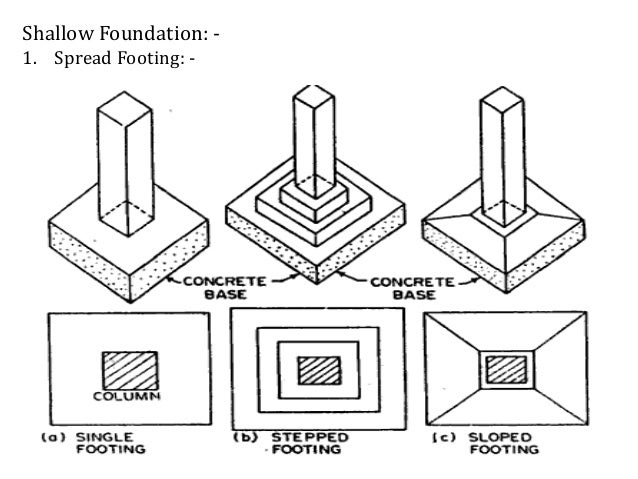
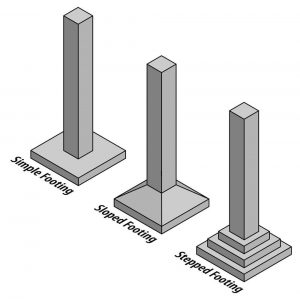
These are either stepped type, type of slate or type of slope with projections in the concrete base. Reinforcement is also provided at the base to support heavy loads.

Raft or Mate foundation:

The foundation that consists of a thick R.C.C slab that covers the entire area in the form of a mat is known as a raft or mat foundation.
The entire area is excavated to the specified depth in the construction of the Raft Foundation.
The bed is compacted and water-sprinkled.
A layer of lime concrete or lean concrete (1:8:16) is then laid to an appropriate thickness to act as a base cover.
The reinforcement is laid after that. The reinforcement consists of closely spaced bars placed between them at right angles.
Then the cement concrete (1:2:4) is laid and compacted to the thickness required.

This type of foundation is useful for public buildings, office buildings, school buildings, residential quarters, etc, where the ground conditions are very poor and bearing power of the soil is so low that individual spread footing cannot be provided.

Image result for raft footing

STEPPED FOUNDATION :

Another type of foundation is stepped foundation, For Stepped Foundation Construction, excavation is performed in steps with the short length and uniform thickness and the masonry work is performed on the horizontal concrete bed thus prepared.
If the structure can be slipped body-wise, R.C.C piles can be driven on the sloping side along with its base concrete.

Image result for stepped footing

Strap footing :

A strap footing is a component of a building's foundation. It is a type of combined footing, consisting of two or more column footings connected by a concrete beam. 
This is the most common type of foundation used where you have a solid soil base and a logged area of nan-water.
With this type of foundation, most small buildings of just one floor are constructed.
Depending on the recommendations of the structural engineer, the size of your foundation for the small building could be 600 mm to 1200 mm.

 Types of deep foundation:

  1. pile foundation
  2. well foundation 

Pile foundation :

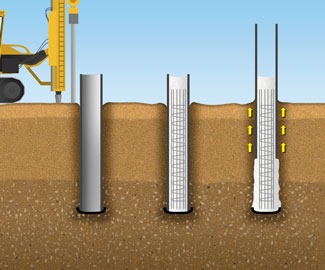
A pile is basically a long cylinder of a strong material like concrete that is pushed into the ground to act as permanent support for structures built on top of it.
The foundations of the pile are deep foundations. These are composed of long, slender, columnar structures that are usually made of steel or reinforced concrete, or sometimes wood. When its depth is more than three times its width, a foundation is described as' piled.
Pile foundations are used when the surface has a layer of weak soil. This surface can not bear the building's weight, therefore the building's loads must bypass this layer and be moved to the layer of stronger soil or rock below the weak layer.
it is also when there are heavy concentrated loads in a house, such as a high-rise tower, bridge, or water tank.

Image result for pile foundation

Types of Pile Foundation  

01. Based on Material:
 Timber pile
 Steel pile
 Concrete pile
 Composite pile 

02. Based on Shape: 
Cylindrical pile
Tapered pile 
Under-reamed pile 

03. Based on Load Transfer Mode:
 End bearing pile
 Friction pile 

04. Based on Construction Method:
 Cast-in-site reinforced concrete 
Precast reinforced concrete 

05. Based on the Installation Method: 
Bored pile 
Driven pile 
Vibrated pile 

Well foundation:

Well foundation is a type of deep foundation that is usually provided for bridges below the water level. Cassions or well have been in use since the Roman and Mughal periods for bridge foundations and other structures.

Monday, December 2, 2019

How to calculate cement sand and aggregate quantity in concrete

Quantities of materials for concrete such as cement, sand, and aggregates for production of required quantity of concrete of given mix proportions such as 1:2:4 (M15), 1:1.5: 3 (M20), 1:1:2 (M25).


We assume that we have 30 cft volume of concrete and the mixing ratio is 1:2:4 (M15).
So we know that the unit weight of concrete is 150 lbs per cubic foot.  so, first of all, we need to find the weight of 30 cft concrete.

Weight of 30 cft concrete 
30 x 150 = 4500 lbs

We know that this is the weight of wet concrete so now we will find the dry weight of concrete.
for converting wet concrete weight to dry concrete weight the weight of wet concrete multiply with 1.54.

(If you want to know why we multiplied it with 1.54 then Read this : 

      Quantity Of Cement And Sand Calculation In Mortar CFT )


Dry weight of concrete 
4500 x 1.54 = 6930 lbs

Now we will calculate the quantity of cement, sand, coarse aggregate and water.

Calculation

First of all, we will find the sum of ratio

Sum of ratio = 1+2+4 = 7

Sum of ratio = 7

Now

Quantity of cement = 
( 1 ÷ 7 ) x 6930 = 990 lbs

We know that 1 Kg = 2.204 lb so

990 ÷ 2.204 = 449.18 kg  say 150 kg

We also know that  the weight of1 bag of cement is 50 Kg so

150 ÷ 50 = 3 bags

Quantity of cement = 3 Bags

Quantity of sand = 
( 2 ÷ 7 ) x 6930 = 1980 lbs

Quantity of sand in kg = 
1980 ÷ 2.204 = 898.36 kg say 900 kg

Quantity of sand = 900kg


Quantity of coarse aggregate = 
( 3 ÷ 7 ) x 6930 = 2970 lbs

Quantity of coarse aggregate in kg = 

2970 ÷ 2.204 = 1347.54 say 1348 kg

Quantity of coarse aggregate= 1348 kg

(Note = 0.4 to 0.6 water-cement ratio used in M15 concrete. we will take o.5 w/c ratio)


Quantity of water = 
0.5 x 150 = 75 liter 

(150 is the weight of cement)

Quantity of water = 75 liters 

Quantity of material in 30 cft:

Cement = 3 bags

Sand = 900 kg

Coarse aggregate = 1348 kg

Water = 75 liters

Sunday, December 1, 2019

What is foundation ? purposes of Foundation and factor effects on Foundation

Many structures like dams, bridges, buildings, roads, etc are created by civil engineers to serve our numerous necessities. Structures apply load on soil on which they rest.
This part of the structure is called sub-structure. Sub-structure is usually called foundation. Thus structural elements that connect, bridges, buildings etc. to the ground are called foundations.
Foundation of any structure is incredibly necessary as a result of the safety and reliability of structure depends upon foundation.

“The lowest part of a structure which transfers a load of superstructure along with its own weight into the soil underneath without carrying shear failure or bearing capacity failure and excessive settlement is called foundation.”


The following are the main functions of the foundation:

• To distribute the load of the structure over a large bearing area to bring the intensity of loading within the safe bearing capacity.
• To load the bearing surface at a uniform rate ( prevent unequal settlement)
• To prevent the lateral movement ( caused by wind, water or earth quick)
• To increase the stability of the building as a whole.


The requirement of a good foundation:

• Foundation should be located that it is able to resist any unexpected future influence which may adversely affect its performance.
• The foundation should be stale against any possible failure.
• The foundation should not settle or deflect.

Factor affecting the selection of foundation:

• Importance of the Building
• Life of the Structure
• Loads from superstructure
• Type of construction materials to be used.
• Water table level.
• Type of adjoining structure.
• Soil condition.
• Location of building

Friday, November 29, 2019

Whole circle bearing (WCB) and Quadrantal Bearing System (QBS) in Surveying

The whole bearing system (WBS) and the quadrantal bearing system (QBS) are two bearings systems used in the compass survey. With a simple calculation, the WCB system can be converted to QBS.

The article briefly explains the different bearings used in the survey and classification of bearings (WCB and QB system).

Bearing and Angles:

You may measure a survey line in relation to another survey line or in relation to the meridian. The first method provides the line angle. The second one is giving the bearing The bearing can, therefore, be defined as the line's direction for the given meridian.

There are mainly three types of meridian: 
  1. True meridian 
  2. Magnetic meridian 
  3. Arbitrary meridian

1. True Meridian:

A line passes through a point, with a plane passing through the point and the north-south poles forming the true meridian.
In other words, it forms the line that passes through the true north and the south poles.
The true bearing of a given line is the horizontal angle made with the true meridian through one of the extremities of the line.

2. Magnetic Meridian

The magnetic meridian is the direction shown by a freely suspended and floating balanced magnetic needle. To determine the magnetic meridian, a magnetic compass can be used. For this purpose, the magnetic compass used must be free of other attractive forces. 
The magnetic bearing of a given line is the horizontal angle that it makes with the magnetic meridian that is passing through one of the extremities of the line.

3. Arbitrary Meridian

In some situations during the survey, a convenient direction is set for a permanent or common mark or signal in the area. These are called arbitrary meridians which help determine the survey line's relative positions.
The horizontal angle made by a line with the arbitrary meridian passing through one of its extremities is called as an arbitrary bearing.

Whole Bearing and Quadrantal Bearing Systems:

A WCB bearing system measures an angle in the clockwise direction from the magnetic north or to the south.


hence, the bearing value varies between 0 degrees and 360 degrees. A WCB system graduates from a prismatic compass. 


The Quadrantal Bearing or Reduced Bearing System (QB):

The bearing angle is measured in the QB system either from the north or from the south, whichever is nearer. In either clockwise or anti-clockwise, this can be measured Here it is necessary to mention the quadrant at which the line lies. The Q.B lines vary from 0 to 90 degrees.


Wednesday, November 27, 2019

Quantity of Cement and Sand Calculation in Mortar m3

A quantity of cement mortar is required for a building or structure to analyze the rate of brickwork and plaster or to estimate the masonry work. Cement mortar is used in different proportions,  i.e. 1:1, 1:2, 1:3, 1:4, 1:6, 1:8 etc.


Calculation of quantity of cement mortar in brickwork and plaster:

Let us assume that we use 1m3 of cement mortar for the calculation of cement mortar. The calculation method is:
1. Calculate the amount of dry material required for 1m3 cement mortar. Considering the voids in the sands we assume the material is consists of voids of 60%. That is, 1.6m3 of materials are needed for 1m3 of wet cement mortar.

2. Now, based on its proportions, we calculate the volume of materials used in cement mortar.

Let's say, the cement and sand ratio is 1:X, where X is the required sand volume.

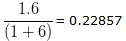
Then, the volume of sand required for 1:X proportion of 1m3 cement mortar will be


3. The volume of cement will be calculated as:


Since the volume of 1 bag of cement is 0.0347 m3, so the number of a bag of cement will be calculated as:
For cement mortar of 1:6, the quantity calculated will be as below:
Sand Quantity:
Quantity of cement (in bags):
The volume of cement = 
There number of bags required =  = 6.58 bags.

Next article= How to find cement and sand quantity in the mortar in Ft3

Sunday, November 24, 2019

What is Soil? Formation and types of Soil?

What is soil?


The term "Soil" has different meanings depending on the field of general professional consideration.
To an agriculturist, Soil is the material on the surface of the earth which grows and produces plant life.
To the Geologist, Soil is the substance in the relatively thin surface area within which there are roots.
To an engineer, Soil is an unconsolidated agglomerate of minerals found on or near the earth's surface with or without organic matter through which and on which engineers build structures.
It covers the entire thickness of the earth's crust that is accessible and feasible for practical use as foundation support or building material.
The behavior of soil as a foundation or building material is heavily influenced by the following:

  • Moisture content present in soil pores
  • The fluctuation of the groundwater table
  • Freezing and thawing phenomena
  • Presence of organic matter
  • History of the formation of soil
  • Seismicity of area
Mechanical or attractive forces bind the particles of the soil together.
The binding strength of the soil is very low compared to the rocks.
The type of soil will differ between clay and gravel and even between cobble and boulders.
The topsoil, normally two feet deep, contains organic matter and is generally considered unacceptable for use in civil engineering.

Formation of soil:

Soil is generally formed by rock decomposition or disintegration (rock weathering) on or near the earth's surface through the action of many natural, physical, and chemical agents that often break them into smaller and smaller particles.
The weathering of rocks may be the following: 
  1. Physical/mechanical weathering
  2. Chemical weathering 

1.Physical/mechanical weathering:

It is the disintegration of rocks caused by changes in temperature, freezing and thawing, swelling, flowing water erosion, natural disasters (earthquake, land sliding, etc.) and animal activities including people. 
Soils formed by physical weathering retain parent rock minerals.
Coarse-grained soils (gravels, sands and their mixtures) are the physical weathering products

2. Chemical weathering:

Weathering caused by oxidation, hydration, carbonation, desilication, and leaching of rock minerals is known as chemical weathering.
The common soils formed by chemical weathering are different types of clay and organic soils (peat, muck, hummus, etc.).

Types of Soil Based on Particle Size:

Types of soil based on engineering considerations depend on particle size. As the engineering properties of soil change with particle size change, different names are given for different particle size ranges. The range of particle size defined for each soil type varies among agencies.

clay:

Composed of fine particles with a size of less than 0.002 mm. Flaky in the form with a large area of the surface. Have a strong attraction of inter-particles and therefore have sufficient cohesion. Poor permeability is vulnerable to swelling and shrinking. Typically the color is brown.

silt:

Composed of particles between 0.002 and 0.06 mm in size. Have high capillarity and dry strength very low. The intermediate particle size between clay and sand, therefore, has sand and clay properties, i.e. it shows slight friction and friction as well. The silty soil color is mostly brown.

Sand:

Particle size from 0.06 to 2 mm, in shape, can be rounded to angular in color brown. No plasticity, high resistance in a confined environment and significant resistance to friction. angular particles have a high resistance to friction compared to rounded particles. It is extremely permeable and has low capillarity.

gravel:

The particle size ranges between 2 and 60 mm. Form good material for the foundation. Show high resistance to friction. Angular particles have a high resistance to friction compared to rounded particles. The gravel produced by rock crushing is angular in shape, while those taken from the riverbeds are sub-rounded to rounded.

Cobbles and Boulders:

Particles larger than gravel are commonly referred to as cobbles or boulders. Cobbles vary between 60 and 200 mm in length. Boulders are the material greater than 200 mm.

Soil types According to ASTM and AASHTO:


Saturday, November 23, 2019

Difference between Tender and Contract Documents

In order to understand the difference between tender documents and contract documents, we must first understand what they contain.

Tender Documents:
A tender is a written offer to contractors to conduct such specified works or to supply specified materials within a specified time period and in compliance with contract and contractual conditions between the contractor and the owner or department or party. 
The tender documents contain the bill of quantities (BOQ), work specifications to be performed, time frame for completing the work, contract conditions and plans and drawings. On the payment of certain fees, these documents are given to the contractor. The contractor who offers the lowest or appropriate rates for the works as a whole is offering the contract to do the work.
OR
It's a document pre-bidding. This document mainly describes four issues, i.e. 1 Contractor Eligibility Criteria, 2 Project Timeline 3 Contract Working Procedure and 4 Quantity Material Specification(BOQ).


In order to obtain tender papers, there are also some limitations. In some cases, only the tender document is available to the contractor who is eligible.
Once the rate is quoted by the contractor in BOQ, it is sealed in cover and submitted to Tender Inviting Authority Panel. At the date of tender opening, the panel will unseal the cover and start to name L1, L2 & L3 respectively to the contractor, who quoted the lowest or appropriate value of three members. Then the negotiation process will take place, the contractor who comes for the lower price to him the tender will be awarded.

Contract Documents:

Contract documents are the arrangement between the owner or the party or agency and the contractor to conduct the works as stated in the tender documents on the rates quoted by the contractor in compliance with the contract conditions.
OR
It is a Post – Bidding Document. This document is a total of an agreement. Once the bidding is over the contractor and client will undergo an agreement that the Project will be completed in scheduled time, with the same specification and working procedure as mentioned in the Tender document. If the project is delayed due to the contractor, then the penalty will cover some percent of the total project cost. This agreement is documented as a Contract Document.

Tender and Contract Documents difference:

The difference to remember here is that tender contracts are given to as many suppliers as possible to receive the lowest offers for the stated work, whereas contract agreements are only signed with the contractor with the appropriate or lowest bid or rates and technical skils.
While the tender documents include the contract terms and all the information for the stated work, in terms of content, there is not much difference between the two. But it is not possible to send tender documents as Letter of Acceptance (LOA) since these are two different types of documents. While a tender document can not bind the contractor to do the work, the contractor is bound by a contract document to complete the work as per the contract.

Simple Example for understanding the difference between tender documents and contract documents:

When you are selected for a job in a company you are offered an offer letter to join the company. But getting selected in a company does not mean that you join the same company, you may have other offer letters as well. But when you sign the letter of acceptance (LOA) for the job, you are bound to join the company. So, here offer letter from the company is a tender document and LOA is the contract document.


Thursday, November 21, 2019

What is Civil Engineering

Engineering:

The use of science and math is engineering to model or construct things and buildings etc. People are called engineers who do engineering.

Civil engineering:

Civil engineering is the word for infrastructure design and construction work. Usually, it means large buildings such as bridges, reservoirs, homes, and tunnels. It also covers complicated networks such as networks for water, irrigation, and sewerage. It also involves building homes and dwellings.

Branches of civil engineering:

Civil Engineering has enormous scope and includes a wide range of sub-disciplines. Within this branch of engineering, there are different fields you can choose to pursue your career. The following are the branches of civil engineering.

1. Construction engineering:

Deals with planning, construction, and maintenance of structures such as houses, schools, plaza, bridges, and dams, etc.

2. Structural engineering:

Deals with Structural Analysis and Design of structures such as Framework of structures and design of structures to withstand environmental stresses and pressures and to remain secure, stable and secure during their use.

3. Geotechnical engineering:

Study of soil, foundations, bearing capacity, etc.

4. Transportation engineering:

Deals with planning, construction, and management of transportation facilities such as roads, etc.

5. Surveying:

Deals with surveying and leveling lands using different instruments, terrain mapping & contouring, etc specially used in road bridges and dams.

6. Water resources engineering:

Deals with design and construction of hydraulic structures like dams, canals, water distribution systems, etc. 

7. Environmental Engineering:

Study of environment-friendly designs, sewage management, pollution, and their treatment.

8. Municipal engineering:

Deals with urban/city planning & management, township, etc.

9. Tunnel engineering:

Deals with planning, design, construction, safety, and maintenance of tunnels.

10. Coastal engineering:

Deals with coastal or marine structures like groynes (groins), embankments, etc.

11. Earthquake engineering:

Study of seismic forces, earth-quake resistant structures, etc.


Importance and Applications of civil engineering (in short)

With time, civil engineers are becoming increasingly important. They are now also responsible for the fire control systems and the installation of rapid-fire exit points in the buildings these construct. This will help minimize the loss of life in accidents involving fire. One of the oldest engineering professions is civil engineering. Classical structures such as the building of the Egyptian pyramids and the Roman road systems are based on principles of civil engineering. Environmental engineering is another very important aspect of civil engineering. In this case, civil engineers are concerned with different methods of purifying contaminated air, water, and soil. It is necessary to clean the polluted system, remove the waste and return the purified constituent to the natural system.
Civil engineers are also responsible for the design of high-quality transport systems such as roads, airports, bridges, marine ports, etc. A structural engineer must decide the best design of these structures and will look after the building process so that after completion the stability of these structures is guaranteed. These structures should also be satisfied for the public.