Thursday, November 28, 2019

Quantity Of Cement And Sand Calculation In Mortar CFT

A quantity of cement mortar is required for a building or structure to analyze the rate of brickwork and plaster or to estimate the masonry work. Cement mortar is used in different proportions,  i.e. 1:1, 1:2, 1:3, 1:4, 1:6, 1:8 etc.


Calculation Of Quantity Of Cement Mortar In Brickwork And Plaster:

Let's assume that the volume of masonry work is 20cft. and we assume the ratio of mortar 1:4.
When we estimate the mortar quantity for any masonry work, we just get the wet volume of mortar.

Now we will see how to calculate the dry volume of mortar and then we will calculate the cement and sand quantity in 20cft.

Grains of sand in dry conditions include air voids. Therefore, by adding water to the dry sand, the sand volume will be reduced This happens because of the presence of air voids in particles of sand. The percentage of air void sand compressibility is between 20% and 27%. 

Normally, when converting the wet volume into the dry volume, we take the highest percentage of air void compressibility of sand. That's 27% of it. 


So when we calculate the dry volume of mortar, we just multiply the wet volume by 1.27.

Dry volume= 20 x 1.27 = 25.4 cft

So now we have the dry volume of mortar which is 25.4 Cft

Now we will calculate the quantity of sand and cement in 25.4 Cft. 

first, we will calculate the sum of ratio and our mixing RATIO IS 1:4.

Sum of ratio= 1+4= 5 


The volume of cement will be calculated as:

(1 ÷ 5) x 25.4 = 5.08 cft

Since the volume of 1 bag of cement is 1.25 Cft, so the number of a bag of cement will be calculated as:


5.08 ÷ 1.25 = 4.064 bags


The volume of Sand will be calculated as:

(4 ÷ 5) x 25.4 = 20.32 cft

Quantity of cement in 20 Cft  masonry mortar = 4.064 Bags say 4.5 or 5 bags

Quantity of cement in 20 Cft  masonry mortar = 20.32 cft

Conclusion 

To calculate the dry mortar volume, you simply need to estimate your work item's wet mortar volume and then multiply it by 1.27.

Once you get the required dry mortar volume the amount of cement and sand required for the mortar can be calculated based on the proportion of the mixture.

Wednesday, November 27, 2019

Quantity of Cement and Sand Calculation in Mortar m3

A quantity of cement mortar is required for a building or structure to analyze the rate of brickwork and plaster or to estimate the masonry work. Cement mortar is used in different proportions,  i.e. 1:1, 1:2, 1:3, 1:4, 1:6, 1:8 etc.


Calculation of quantity of cement mortar in brickwork and plaster:

Let us assume that we use 1m3 of cement mortar for the calculation of cement mortar. The calculation method is:
1. Calculate the amount of dry material required for 1m3 cement mortar. Considering the voids in the sands we assume the material is consists of voids of 60%. That is, 1.6m3 of materials are needed for 1m3 of wet cement mortar.

2. Now, based on its proportions, we calculate the volume of materials used in cement mortar.

Let's say, the cement and sand ratio is 1:X, where X is the required sand volume.

Then, the volume of sand required for 1:X proportion of 1m3 cement mortar will be


3. The volume of cement will be calculated as:


Since the volume of 1 bag of cement is 0.0347 m3, so the number of a bag of cement will be calculated as:
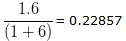
For cement mortar of 1:6, the quantity calculated will be as below:
Sand Quantity:
Quantity of cement (in bags):
The volume of cement = 
There number of bags required =  = 6.58 bags.

Next article= How to find cement and sand quantity in the mortar in Ft3

Saturday, November 23, 2019

Sieve Analysis of Coarse Aggregate ASTM : Explanation and Procedure of TEST Step by Step

TO FIND THE GRADATION OF COARSE AGGREGATE BY SIEVE ANALYSIS (ASTM C136-05).

THEORY & IMPORTANCE:
This experiment is conducted to find and check coarse aggregate gradation i.e. crush.  The main bulky component of the concrete is crush; it is used together with its strength-giving properties to increase the volume of the concrete. it calculates its fineness module to find the water ratio to be used, along with the value of the specific crush gravity and its maximum grain size.
The maximum size of the coarse aggregate will be calculated from the modulus fineness table in this experiment. For example, if its maximum size is 3⁄4 inches, it means that all grain size is less than 3⁄4 inches. This can also be expressed by writing it as a crush: 3⁄4 inch down.

APPARATUS DETAILS:

For this gradation, the sieve used is 1 1⁄2 in, 1 in, 3⁄4 in, 1⁄2 in, 3/8 in, and #4 sieve. The distinction is that #4 sieve means that in one linear inch of the sieve there are four holes, while 1 1⁄2 inch sieve means the one side dimension of the sieve hole is 1 1⁄2 inches (not that in one linear inch of the sieve there are one and a half inches). The sieves are stacked with their lengths in ascending order. The crushed sample here is 3000 g.

APPARATUS:

  • Sieve Apparatus or sieve set.
  • Electronic Balance.
  • Brittle brush.
  • Empty plate.

Electronic Scale
Sieve Set & shaker


MATERIAL:

Sample of Coarse aggregate

PROCEDURE: 

Ø  Took the digital balance and set the scale reading to zero
Ø  Took and measured the weight of pan.
Ø  Put some crush in the pan and measure 3000 grams of crush with the help of electronic balance.
Ø  Put the crush in a sieve of 1. 5 inches and began shaking until no more seeds could escape it readily. Using the electronic balance, measured the weight retained on the sieve and noted it in the table.
Ø  Some stone had fallen out of the reduced sieve placed it in it and begins to shake the sieve for sufficient time. Noted the sieves read of the retained weight.
Ø  Similarly, placed the entire remaining crush in the below sieve and began shaking for enough moment and noticed the weight retained in all the sieves.
Ø  Calculated the percentage of each sieve's weight retained.
Ø  The percentage of the weight that had passed through each sieve was found in the next phase.  The complete quantity entered will be 3000 grams for 1.5 inch sieve.
Ø  But it won't be the same for the 1 inch sieve because the upper sieve had retained some weight, so the proportion of the passing was calculated relative to the quantity that enters that sieve.
Ø  For a sieve of 3⁄4 inches, the total quantity entering the sieve will be less the value for the upper sieve, similarly, for other sieves, the same method should be used to calculate the percentage of the passed weight
Ø  The cumulative proportion was calculated in the next column.  This was the weight proportion that would be retained if the crush were placed directly on the sieve.  It will be the same as it was for 1. 5 inch sieve, but for 1-inch sieve, it would be the sum of the proportion retained by 1. 5 inch sieve plus the one retained.  Similarly, the cumulative proportion was calculated for other sieves, this was denoted by a1, a2, a3, etc
Ø Then at the end to find the crush's fineness module add each sieve's cumulative proportion and divide it by 100.

Observations and Calculations:

Total weight of natural coarse aggregate = 3kg.

Sieve
No
Weight
Retained on
Sieve (kg)
Percentage
of weight
Retained
(%)
Percentage
Of weight
Passed
(%)
Cumulative
Percentage
of Retained
(%)
1 in
0
0
100
0
3/4 in
0.3594
11.98
88.02
11.98
1/2 in
1.1526
38.42
49.6
50.40
3/8 in
0.9732
32.44
12.16
82.84
#4
0.489
16.30
0.86
99.14

Finess modulus formula= a1+a2+a3+a4+a5 / 100
(Note:- a is the Cumulative Percentage of Retained (%) )
Finess modulus= 244.36/100=2.44